Venice canals and quiet streets
Travel / Venice

Venice Guide

Local notes for walking the sestieri, using the vaporetto, eating cicchetti, and seeing the lagoon without treating Venice like a checklist.

Start here

Venice is easier when you accept that it works differently.

The original guide was written as advice for friends, so this version keeps the same practical tone: what is crowded, what is worth a detour, where locals actually walk, and which famous places are better seen at the right time.

It is not a complete encyclopedia of Venice. It is a field guide to the main island, the lagoon islands, food, bacari, and the small orientation details that make the city less confusing.

Transport and orientation

No cars, a difficult map, and a city vocabulary of its own.

Public transport in Venice mainly means the vaporetto. A single ticket is useful for a short ride, but if you plan to move often by water, compare the 24, 48, 72-hour and 7-day tourist cards on Venezia Unica before travelling. Water taxis and gondolas are much more expensive; the cheapest scenic ride is still a vaporetto along the Grand Canal, especially at night.

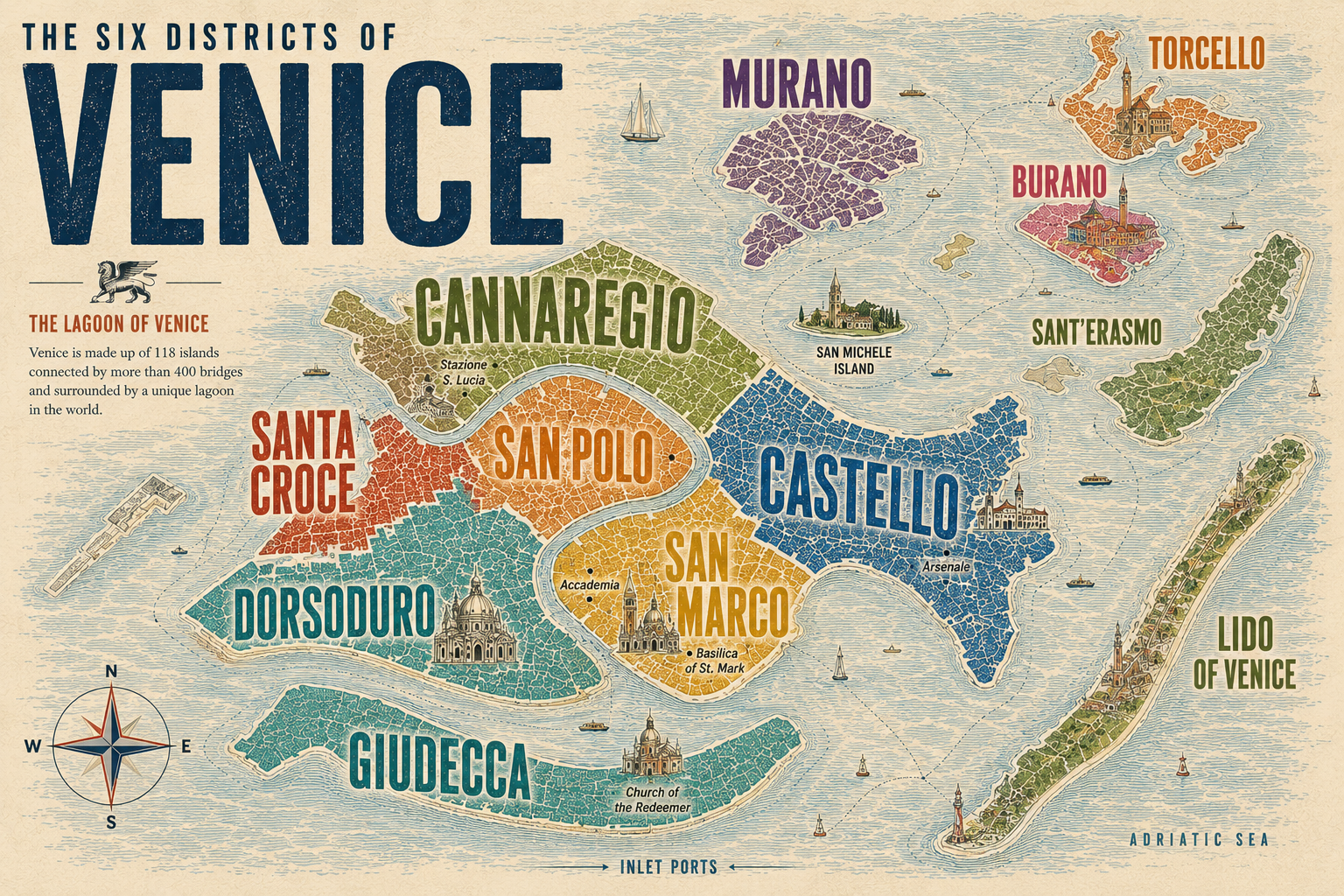
GPS can be unreliable between narrow calli, bridges, and dense buildings. Download an offline map or keep a paper one. The city has six sestieri: Santa Croce, Cannaregio, Dorsoduro, San Polo, San Marco, and Castello. The Grand Canal cuts through the main island in an S shape, and the Giudecca Canal separates the main island from Giudecca.

Venetian street names are part of the orientation: calle, ramo, and fondamenta are streets; campo, campiello, and corte are squares; rio and canal are waterways. Only Piazza San Marco is called a piazza.

Main island / sestieri

San Marco and San Polo are usually the most crowded because of Piazza San Marco and Rialto. Dorsoduro, Cannaregio, and Castello are where the city opens up. Santa Croce is less famous, partly because its western edge is the practical gateway for cars, buses, and trains.

Illustrated map of Venice showing the six sestieri and nearby lagoon islands
Reference map for the six historic sestieri. The map also shows nearby lagoon islands; Giudecca is part of Dorsoduro, while Murano, Burano, Torcello, Lido, and Sant'Erasmo are separate island references.

Santa Croce

The practical entrance to Venice, with a few quiet stops.

This is not the area most visitors come to see first. The western part is where locals park cars and where many mainland connections arrive. Still, it has good details if you are already nearby.

  • Churches: San Giacomo dell'Orio, San Stae, Tolentino, San Simeon Grande, and San Simeon Piccolo.
  • Architecture and views: Fontego dei Turchi, Ponte degli Scalzi, the station exterior, and Ponte della Costituzione by Calatrava.
  • Museums: Palazzo Mocenigo for textiles and Ca' Pesaro for modern art.
  • Walk: start at Ponte della Costituzione and continue along Ferrovia.

Dorsoduro

Students, Zattere, the Accademia view, and the Dogana.

Dorsoduro is lively because of Ca' Foscari and IUAV. It is also one of the best areas for a long walk with water views and less pressure from the San Marco crowd.

  • Churches: Santa Maria della Salute and the Gesuati, with Tiepolo and Tintoretto.
  • Views: Punta della Dogana, Ponte dell'Accademia, Ponte dei Pugni, Squero San Trovaso, Calle Varisco, and Campo Santa Margherita.
  • Museums: Peggy Guggenheim Collection and Gallerie dell'Accademia.
  • Walk: start at Squero San Trovaso, follow Fondamenta delle Zattere, and continue to Punta della Dogana.

Cannaregio

The Ghetto, northern lagoon views, and a strong bacaro route.

Cannaregio is known for the Jewish Ghetto and for walks that feel more local than the San Marco to Rialto corridor. Fondamenta degli Ormesini and Rio della Misericordia are especially useful for food and evening stops.

  • Churches: Madonna dell'Orto, strongly recommended in the original notes, plus the Scalzi near the station.
  • Architecture and views: Ghetto Ebraico, Ca' d'Oro, Despar Teatro Italia, Ponte delle Guglie, and Ponte dei Tre Archi.
  • Walks: follow Fondamenta degli Ormesini, continue along Fondamenta Cannaregio for Ponte della Liberta and the western lagoon, or go to Fondamenta Nove for San Michele and northern lagoon views.

San Polo

Rialto is a must, but go early and move beyond the bridge.

San Polo has the Rialto Bridge, so it is inevitably crowded. The useful way to see it is early, around the market, and with enough time for the churches and smaller campi.

  • Churches: Basilica dei Frari.
  • Architecture and views: Scuola Grande di San Rocco, Casa di Carlo Goldoni, Ponte delle Tette, Campo San Polo, and Fondaco dei Tedeschi.
  • Market: Rialto Market is small and best early. Even when closed, the canal side gives a different view of the area.
  • Seasonal notes: look for moeche, soft-shell crabs, and castraure, Venetian artichokes, when they are in season.

San Marco

The famous sights are here, but the details matter.

Yes, Piazza San Marco, the Basilica, Palazzo Ducale, and Ponte dei Sospiri are here. Go early or at night, then look for the places nearby that many visitors miss.

  • Details: Scala del Bovolo, Negozio Olivetti by Carlo Scarpa, Bacino Orseolo, Torre dell'Orologio with the two Moors, and Teatro La Fenice.
  • Bridge views: Ponte della Paglia is the classic crowded view of Ponte dei Sospiri; Ponte della Canonica gives another view with less pressure.
  • Walk: from Negozio Olivetti, go toward Ponte del Cavalletto and Sottoportego del Cavalletto, continue to Ponte di Goldoni, then make your way toward Ponte dell'Accademia.

Castello

Riva walks, gardens, Arsenale, and Biennale territory.

Castello is where Venice starts to breathe again after San Marco. It has the Arsenale, Biennale spaces, gardens, and one of the best long waterfront walks.

  • Architecture and views: Hotel Danieli ground floor, Libreria Acqua Alta, Campo Santi Giovanni e Paolo, Arsenale, and San Francesco della Vigna.
  • Gardens: Giardini della Biennale and Sant'Elena; stop around Caffe La Serra for a spritz.
  • Walk: from Ponte della Paglia, follow Riva degli Schiavoni to Via Garibaldi, continue through the gates to Riva Sette Martiri, then reach the Biennale gardens and Viale IV Novembre.

Lagoon islands

Classic islands

Giudecca gives strong views of San Marco, especially from the Molino Stucky rooftop. Murano is for glass, Burano for colour and lace, and Torcello for quiet history with the Devil's Bridge and Attila's Throne.

Views and beaches

San Giorgio Maggiore is worth it for the bell tower view over San Marco. Lido is the beach island, allows cars, hosts the Film Festival, and feels more posh in summer.

After the main list

San Michele is the Venetian cemetery. Vignole is wilder and useful in summer for a simple meal. Lio Piccolo is a lagoon cycling idea with agriturismo stops, best after you have already seen the main parts of Venice.

Typical Venetian food

Think small bites, simple dishes, and local timing.

The original notes divide food into quick sandwiches, bacaro snacks, first courses, second courses, drinks, and biscuits. You do not need antipasto, first, second, and dessert every time; usually one first or second plus either antipasto or dessert is enough.

Start with tramezzini, mozzarella in carrozza, cicchetti, and an ombra. Then look for bigoi in salsa, scampi alla busara, risi e bisi, risotto di go, baccala mantecato, sarde in saor, schie con polenta, fegato alla veneziana, and moeche when the season is right.

Tramezzini
Soft white bread triangles with fillings such as tuna, tuna with olives or eggs, ham and mushrooms, or mozzarella and tomato. The old guide treats them as a local point of pride.
Cicchetti
Small bacaro bites: crostini, baccala mantecato, meatballs, marinated seafood, and fried snacks. Eat standing or perched at the counter with a small glass of wine.
Spritz and ombra
Spritz is from Veneto; Select is the Venetian bitter, less sweet than Aperol. "Un ombra de vin" means a small glass of wine.
Wine
Common choices from northeast Italy include Merlot, Cabernet, Valpolicella, Amarone, Collio, Pinot Grigio, Friulano, Ribolla gialla, and Prosecco.
Biscuits
Baicoli are dry biscuits historically suited to sea journeys. Bussolai are large butter and vanilla biscuits, often circular.

Eating in Venice

Historical rooms

Harry's Bar, Caffe Florian, and Quadri are expensive and touristy, but important historical rooms. Go for the interiors, decoration, and atmosphere, not for value.

Fancy restaurants

Venissa is more local-ingredient fine dining than traditional home cooking. Da Fiore is one of the known names for Venetian food in the historic centre.

Bacari

A bacaro is the closest Venetian equivalent to a family-run pub or osteria: quick bites, small plates, wine, and a route through the city rather than one long dinner.

Bacaro tour

Build dinner as a walk.

Check opening times. Some bacari only work well between late afternoon and early evening, and many close earlier than a normal restaurant.

  • Piazzale Roma to Cannaregio: Bar Filovia for a simple first or last stop with tramezzini and spritz.
  • Cannaregio: Paradiso Perduto, Al Timon, Vedova for meatballs, Cantina Vecia Carbonera, Taverna al Remer, and the Rio della Misericordia route.
  • Rialto: Corte dell'Orso and Rosticceria Gislon for mozzarella in carrozza.
  • Dorsoduro: Osteria al Squero, facing one of the few remaining gondola workshops, and Campo Santa Margherita for the student area.

Carnival

Go for the atmosphere, but expect crowds.

Carnival has many official events, especially around San Marco and the Arsenale. The old notes suggest the Arsenale water show as one of the more interesting organised events, while also being honest that some famous traditions are more symbolic than spectacular.

Weekends can be extremely crowded, and San Marco may become difficult to enter. Weekdays are easier. If you want the full experience, a proper Carnival dinner in costume is the version to research and book carefully.

Try frittelle and galani. Frittelle are small fried pastries; the original Venetian version is simple, with raisins, though custard and zabaione versions are common. Galani are thin fried pastries with sugar. For pastry shops, keep Rosa Salva and Tonolo on the list, and be suspicious of tourist-area shops selling generic sweets from every region.

Suggested walks

First Venice walk

Start early at Rialto, cross toward San Marco, see the main square, then move through Negozio Olivetti, Ponte di Goldoni, and toward Ponte dell'Accademia.

Dorsoduro to Dogana

Start at Squero San Trovaso, walk the Zattere, continue to Punta della Dogana, then return through Santa Maria della Salute and Campo Santa Margherita.

Cannaregio evening

Walk the Ghetto, Fondamenta degli Ormesini, Rio della Misericordia, and use bacari as the structure of dinner.

Castello waterfront

From Ponte della Paglia, follow Riva degli Schiavoni to Via Garibaldi, Riva Sette Martiri, Giardini della Biennale, and Viale IV Novembre.

Grand Canal by night

Use the vaporetto as the viewpoint. It is affordable compared with private boats and shows the illuminated palazzi without needing a formal tour.

Island day

Choose Murano, Burano, and Torcello for the classic route, or San Giorgio and Giudecca for views without spending the whole day moving between islands.